

Everything Changes Everything
A conversation with author Lauren Kessler on the business of writing

Dear Fabulous Female Founders,
Today, I’m honored to introduce you to a founder whose business is words: Lauren Kessler, the esteemed author of 15 books(!), including her just released memoir Everything Changes Everything.
This book is gorgeous. Not “ooh pretty cover” gorgeous (though yes), but structurally gorgeous—the way a well-designed bridge is gorgeous, the way a perfectly braided challah is gorgeous, the way a sentence can make you stop mid-breath.
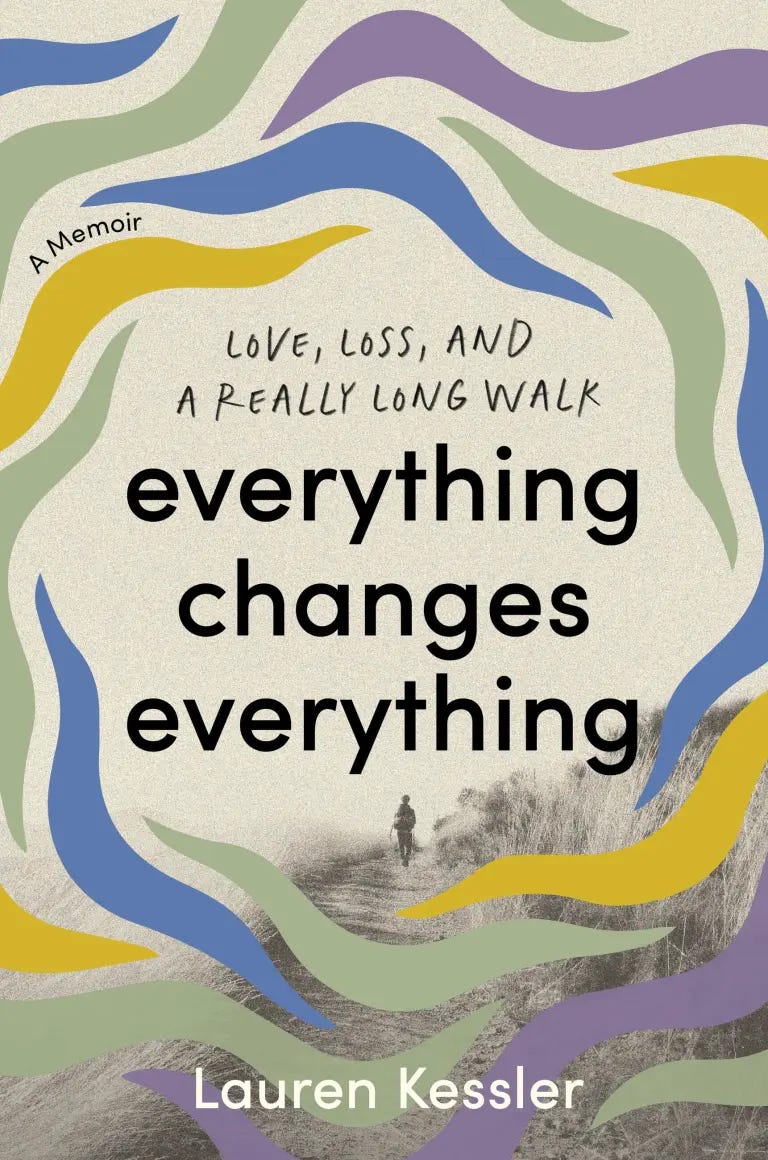
Lauren tells her story in three strands:
her long, lovely relationship with her husband, who died of cancer, on his own terms, surrounded by his family;
her daughter’s life and death shaped by addiction;
and Lauren herself, walking the Camino de Santiago in Spain, moving forward on foot while her mind moves backward through memory, grief, and love.
I loved the way she braided the three narratives: her husband’s told backwards, starting with his death; her daughter’s told forward, starting with her birth; hers on El Camino, stepping through sadness and joy and experiencing moments of stress or fear or worry that transitioned to (or existed simultaneously with) resolution or understanding or peace.
Everything Changes Everything is a departure from her previous narrative nonfiction books for which used a method called immersive journalism. In Free, she writes about six formerly incarcerated people as they attempt to reenter society, people she got to know by volunteering at a prison. In Dancing with Rose, about Alzheimer’s, she worked at a memory care facility. For Raising the Barre, she joined a professional touring ballet company.
She’s delved into other genres too, including a biography of WWII spy Elizabeth Bentley (Clever Girl); Stubborn Twig, which traces three generations of a Japanese American family; and her best-seller of all time, When Words Collide, a textbook.
🌿🚶♀️🌿
I met Lauren about a year and a half ago when she accompanied my ex-husband to San Luis Obispo for my daughter’s college graduation.
Lauren carries this soft, hippy, wise-warm-humble energy that makes you feel calmer simply by standing within conversational range. I liked her immediately, surprising exactly no one, including me, for my ex has good taste in women (obviously.)
I was bummed when the relationship ended, because I want my ex to be happy, and because I really liked Lauren. And because life is funny and strange, Lauren and I stayed in touch through our Substack columns. (If you like tender insight about life as it actually is—messy, bittersweet, absurd—subscribe to Life, After All.)
Lauren then sent me an advance copy of Everything Changes Everything, which I devoured in a weekend. I took notes, underlined lines, pondered, and cried.

🌿🚶♀️🌿
In founder-land, it’s easy to get sucked into the myth that everyone is raising money, building, scaling, driving at top speed toward a lucrative exit. Many are, don’t get me wrong, women I’ve introduced you to like Shraysi Tandon of Kidsy and Callie Christiansen and Kelly Oriard of Slumberkins. But let’s not forget that most of us aren’t venture-backed or anything backed. Most of us create and build businesses simply as livelihood and have to learn the levers and tools to derive income from effort, no easy task.
Lauren isn’t just a wonderful writer, she’s deeply fluent in the business of writing. She told me, “The smarter you get about the business, the more cautious you get about believing any one moment will be ‘the breakthrough.’ For some people, lightning strikes. For most of us, success is incremental. Book by book. Year by year. Essay by essay. Launch by launch.”
I would also add on her behalf: award by award, for she’s been nominated for and won a ton (she’s the only writer in history to win three Oregon Book Awards), but is too modest to brag.
Speaking of breakthrough moments, back in 2001, David Letterman was walking past The Strand bookstore in NYC and saw, bought, and read Lauren’s The Happy Bottom Riding Club, a biography of aviator Florence Pancho Barnes. He then selected it, in playful competition with Oprah, as the first (and only) book for “Dave’s Book Club.” His people called her people—that is, her—and she flew out to appear on his show. For 48 exciting hours, sales exploded, taking the book from obscurity to #7 on Amazon, after which they sunk back to earth. (Read When Jon Stewart saved Citi Bike and My Tedx Talk Didn’t Go Viral, but My Panic Attack Almost Did for variations on the theme.)
“Hope can energize you. Hope can keep you moving. Hope can keep you writing, building, parenting, fundraising, healing. But hope doesn’t replace strategy. It doesn’t replace math. It doesn’t replace understanding the system you’re operating inside.” ~Lauren.
Lauren spoke about the hard line many try to draw between art and business, as if the presence of one contaminates the other. That line—art: pure, business: dirty—sounds noble, until you try to pay rent.
“If you want to support yourself through your art, you don’t have to sell your soul,” says Lauren.
But you do have to give up something: time. Time to understand the industry. Time to learn how publishing works, who owns what, who does what, where the money goes, and why the royalty math makes writers laugh-cry into their coffee. Lauren teaches, speaks, publishes short pieces, and always has another proposal in the wings, a portfolio centered around her writing, beauty and hard work combining to pay the bills.
She offered an analogy: loving shoes doesn’t mean you can start ShoesCo without learning anything about selling shoes. Who’s the customer? What’s the niche? Who are the competitors? What’s the distribution system? What’s the margin?
If you want to earn a living by writing, it’s no different, nor in any business. In my own founder journey, my partners and I spun off an operations firm despite our lack of operations knowledge; as a result, we were in perpetual catch-up mode. But we weren’t alone in the ways writers are.
🌿🚶♀️🌿
Lauren described her business as a kind of project-based enterprise, with a constant core team comprised of Lauren and her agent. Then, each book pulls in a rotating constellation of specialists: editor, cover designer, interior designer, copy editor, marketer, publicist. Most of the time, those people come through her publisher. Sometimes they’re hired independently. Sometimes the promises outpace what anyone can control.
Each book is a three to four year project; as per traditional publishing, Lauren gets a small piece of sales after advances and agent fees.
Her business sounds familiar to founder-life in many ways:
You build teams around seasons.
You scale up and down.
You learn what you can outsource and what you can’t.
You discover what people say they’ll do and what they actually do.
You keep going anyway.
🌿🚶♀️🌿
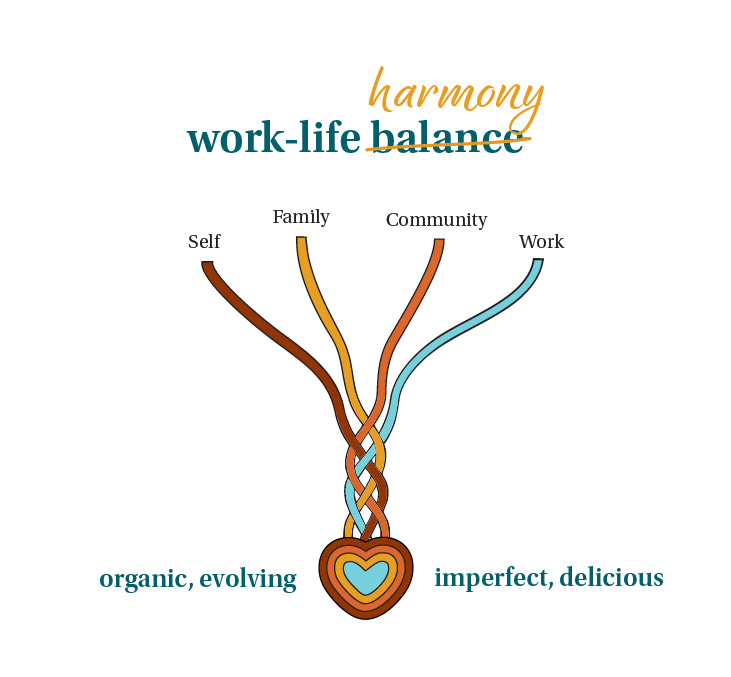
Lauren’s braided book structure brought me to my oft-touted concept of a metaphoric multi-strand braid of career/money + self-care + family + community, rather than the unattainable work-life “balance” paradigm that sets us up for perpetual failure.
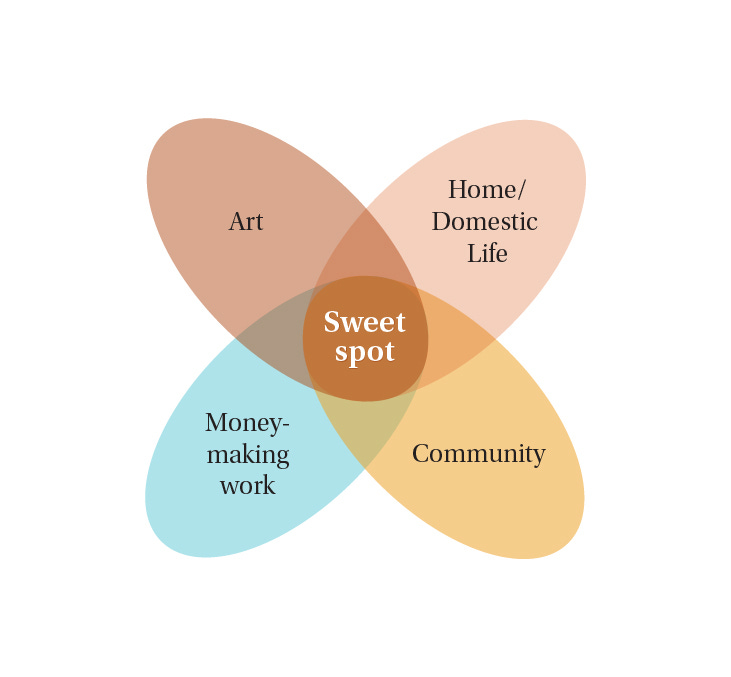
Lauren’s cousin metaphor is a Venn diagram as shown below, with the goal being to find your sweet spot, the intersection that feels true, for that moment, and accepting that the sweet spot changes when life changes.
One kid becomes three. A parent or child or partner gets sick. A book comes out. A divorce happens. A body ages. A business shifts. Kids graduate from high school, get married, have kids of their own. A pandemic blows up the world.
Or in Lauren’s case, your husband and daughter pass away in the same year, and you set off on El Camino, where you walk and talk and think and absorb beautiful scenery and drink wine and heal.
The circles move. The overlap changes.
The work becomes: create a life you can live, day by day, feeling true to the parts of who you are.
That, to me, is founder wisdom. Not hustle-culture wisdom. Not manifesting wisdom. Actual, lived, earned wisdom.
🌿🚶♀️🌿
If you’re building something—company, creative life, career, platform, family—here are some thoughts you can take away from my conversation with Lauren:
Play the long game.
Stop waiting for a single breakthrough to save you.
Learn the business you’re in without treating it like moral compromise.
Build a portfolio life that supports the art.
Let grief and joy sit at the same table.
Keep moving forward, literally or metaphorically, especially when the world stops making sense.
And if you needed a final permission slip, Lauren offers it in the title of her Substack, and in the Indigo Girls lyric she loves:
It’s only life, after all.
With admiration for the artists who learn the math,
~ Mia
What’s making me happy:
The lightness of no longer having to spend eons and oodles dealing with my commercial building (sold!); the transformation of Cider from pissed off psycho cat to cuddly, sweet girl thanks to the exit of Sasha’s little one-eyed bully boy; the sweet smell of Daphne and winter Jasmine in my yard; V.E. Schwab’s Bury Our Bones in the Midnight Soil.
What’s making me sad:
I miss the Olympics, the nights we spent smooshed together on the couch, marveling at the insanity of sliding down a tube head- or feet-first at a zillion miles per hour; spinning dizzily on ice while holding overhead in ONE HAND a woman doing the sideways splits; jumping/somersaulting/spinning five stories high on skis or snowboards, then landing backwards, etc… Thanks for the entertainment, all you amazing athletes and everyone who had a finger in bringing it to our den night after night. Come back soon, ya hear?
Congratulations Lauren!! This is a beautiful reflection, Mia, on the creative process and business of writing. Also, an excellent review!!