

Pitch Perfect
Nobody owes you funding, customers, contracts, or belief. Your job is to earn it.

Dear FFF,
I’m on a panel today for PDX Startup Week, talking about pitches, so I thought I’d go ahead and send y’all a few thoughts, starting with a recent experience I had helping Eastside Jewish Commons, the non-profit I co-founded, apply for a $50,000 grant.
For the interview, the granting agency gave us an hour and a list of questions. Past grant recipients told us to keep it short and informal; panelists all had our application and presumably knew us.
“I just show up and talk,” one grantee told me.
“They always give us money,” said another. “So it doesn’t matter.”
Excuse me? Just show up? Unprepared?
No. I reject this entitlement approach completely.
I don’t care whether it’s a consulting contract, grant, bank loan, or venture raise. When you are asking someone to believe in your vision—and especially when you are asking them to fund it—you show up prepared.
You rehearse. You answer the questions being asked, while anticipating others. You know your numbers cold. You understand how the money will be used, measured, accounted for, and turned into impact.
My partners and I built a $25 million active transportation consulting firm and $60 million bike share operations company this way: by showing up every single day understanding that we were entitled to nothing. Not contracts. Not clients. Not stakeholder confidence. Not public support. Nothing.
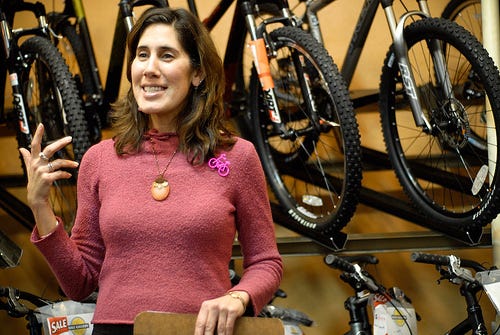
For Eastside Jewish Commons, $50,000 was a lot of money—roughly 10% of our annual budget. You better believe we showed up.
No, we didn’t assume that all the panelists had fully read the materials; these were volunteers, generous with their time and juggling busy lives. It wasn’t their job to become experts in our organization.
No, we didn’t just “show up and talk.”
We built a thoughtful PowerPoint presentation with vibrant photos and charts rather than soul-killing bullets and words. We wove answers to their questions into a compelling story. We stayed high-level on mission and then got wonderfully granular on the finances. We anticipated concerns before they surfaced. We practiced transitions.
We showed up with energy, joy, and boxes of chocolates.
We showed up with humility, gratitude, and respect for the process.
And yes, we received full funding.
Assume nothing, unless you want to make an ASS out of U and ME.
🎤💰✨
In my consulting business, we ALWAYS rehearsed for interviews.
We tailored every presentation to the audience in the room: engineers, planners, elected officials, neighborhood advocates, procurement staff, designers, transportation managers, etc…, because different audiences care about different things. Great pitches recognize this, perfectly match the decision-making criteria, and nail the problem and proposed solution, finances, team, and timing.
In the bike share business, the stakes became even bigger, for we weren’t just pitching for contracts, but for sponsorships, loans, lines of credit, and public-private partnerships worth tens of millions of dollars. Yet, the fundamentals never changed.
🎤💰✨
In my closest circle of friends are leaders of world-changing non-profits and not a single one would “just show up and talk.” Also in my circle are grantors, as am I. Those who wing it show us that that’s how they’ll care for our grants.
These days I review and/or listen to founder pitches a couple times a week, and still, the same lessons apply. Please dress professionally and ensure a non-distracting zoom background. Don’t send me your 99-slide deck for a company based in Canada when our guidelines clearly state we only fund American companies. Don’t fill your slides with your personal trauma story. Don’t gloss over your precarious funding situation and thin to non-existent team. Don’t ask the investor to solve your problems.
An example: I was on a zoom with a founder who’d developed an AI-platform (haven’t they all?)
Problem: check. Her industry was screaming for evolution.
Solution: looked good, from what we could tell.
The founder: smart, visionary, no business experience. (Warning bells softly ringing.)
The team: had secured a promising software developer.
Traction: some.
Competitors: many, with at least one hot on her heels or possibly way ahead, given how fast things move these days. (Warning lights flashing.)
Finances: slim runway, relying on fundraising to survive. (Clang, clang, clang.) But raising money takes time; who else she was talking to?
She looked to the heavens and asked, “Ummm…who should I be talking to? You know, I did meet a guy at a conference recently, hmm…let me think…what was his name?” (Meeting adjourned.)
🎤💰✨
Look, nobody expects founders or grant seekers or to have all the answers. But we do expect them to know the questions.
Plans change, markets shift, competitors emerge, and hard things happen. What investors/grantors/bankers are trying to determine is whether you are the kind of leader who can navigate uncertainty without looking around the room hoping someone else will save you.
Those who consistently raise money are grounded, self-aware, and clear.
Not entitled. Not chaotic. Not winging it.
Just deeply prepared, because preparation itself communicates something powerful: stewardship. It tells the people across the table, “I will treat your money, your trust, and your belief with care.”
~ Mia