

Time Travel by PowerPoint

Dear FFF,
I am generally a person who embraces change, and when I move on, I move on. Past careers, identities, cities, eras of my life—I have learned how to shed them like snakeskin, grateful for what they taught me but rarely tempted to crawl back inside.
But every once in a while, something pulls me backward through time.
A few weeks ago, I was invited to give a talk for a library audience in Columbia, Missouri, about my book, Joyride: Pedaling Toward a Healthier Planet. The book came out in 2010, which feels like another geological era entirely, back when people still printed MapQuest directions, Instagram didn’t exist yet, and “influencer” wasn’t a job description.
For those unfamiliar, Joyride was about more than bicycle transportation. The book was also about change: how change happens at the tiniest, most granular level—down in the potholes and pavement markings and bike racks—and also at the macro level of public policy, funding, leadership, culture, emotion, fear, identity, and hope.
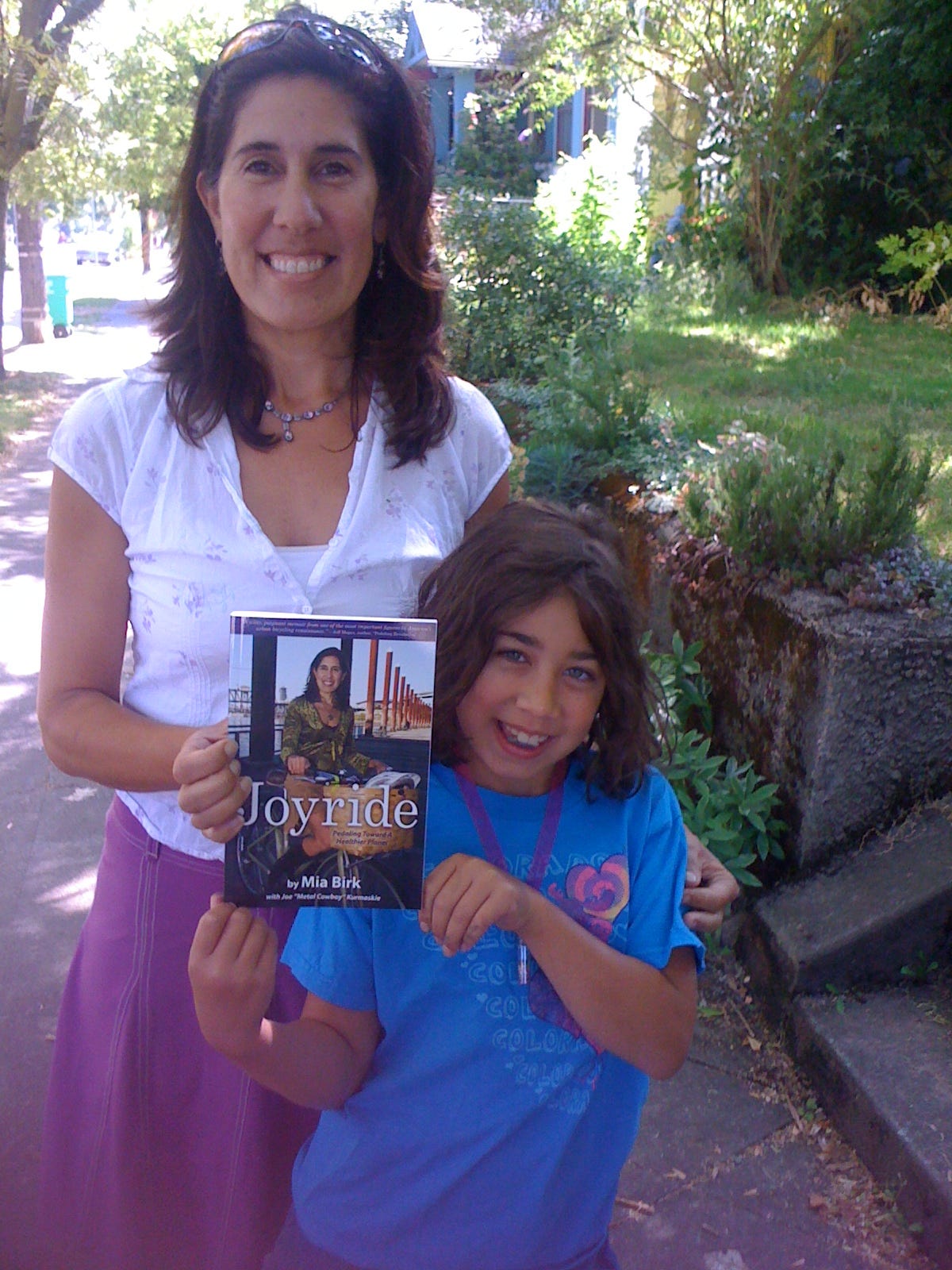
Back then, I traveled constantly. At one point I spoke in sixty cities in rapid succession, giving presentations and trainings and keynote speeches to audiences ranging from skeptical traffic engineers to energized activists to politicians and students. I practically lived inside PowerPoint.
About ten years ago, I stepped away from the field and built a portfolio career supporting female founders like you.
However, when you spend twenty-seven years creating and leading a movement, people still remember your name. That’s why occasionally I still get invited back into that world, like a retired athlete asked to come throw the ceremonial first pitch.
So there I was, sixteen years after Joyride’s publication, sitting in my home office in Portland while a librarian in Missouri projected my face to a public meeting room.
I pulled up one of my old presentations: growing up in Texas, where almost nobody rode bikes and where the very idea of bicycling as transportation felt bizarre, then moving to Portland and leading the nation’s bicycle revolution. I showed before and after photos, explaining how change happened incrementally, through thousands upon thousands of tiny decisions stacked together like bricks.
After a half hour, I stopped and the librarian rotated her device around so I could see the audience: a couple in the front, one guy in the corner, a few scattered in the back… not quite enough for a ceremonial minyan. Instantly, I was transported to an eerily similar scene in a suburban auditorium outside Portland circa 2010. Back then, my talks were usually well attended, but this one? Nearly empty. The organizers looked baffled too, though they asked me to continue since the event was being broadcast on cable television.
With no crowd feedback—no laughter, no one to lock eyes with—I zipped through at warp speed. At the end, I asked—out of pure muscle memory—whether anyone had questions.
A large man sitting alone near the back raised his hand.
“Yeah,” he called out. “Why are you here?”
Turns out the organizers had forgotten one tiny detail: advertising the event. The lone audience member had simply wandered in off the street and had absolutely no idea who I was.
Anyway, back in the Missouri library, folks had real questions, like:
How do we get traffic engineers to understand bicycle transportation?1
We’ve gotten criticism that bicycling is just for affluent White people and hipsters. How do we address this?2
Does messaging around climate change motivate people to bike?3
I have answered these same questions approximately one billion times, and I had a strange sensation of being two people at once: the younger version of myself, in rooms and on stages trying to convince America that cities could change, and the older version of myself, watching from a distance with the perspective of time.
When I began my work in active transportation, bikeways, neighborhood greenways, parking corrals, Sunday Parkways, Safe Routes to School programs, protected cycle tracks, and bike share systems were close to non-existent. An entire generation, not just in Portland but in hundreds of cities (although perhaps not in Columbia, MO, not yet) has grown up inside changes that once seemed politically impossible.
That’s the strange paradox of systems work, and honestly, of founder life too: while you are building it, progress can feel microscopic. You spend years answering the same questions, fighting the same resistance, having the same exhausting conversations over and over and over again.
Then one day you look up and realize the world has quietly transformed around you. Not perfectly or evenly but undeniably.
~ Mia
We take them out on bicycles to see the good, the bad, and the ugly. We empower them to solve problems. We lead, teach, and celebrate them.
Hire brand ambassadors. Take time to engage in deep cultural work. Make sure your network appeals to all, especially those (about 60% of the population) who generally think bicycling is a good idea but have concerns about safety. Understand that bicycling is but one tool in a toolkit, appropriate for some, not all, people and trips.
No. People do not suddenly start bicycling because someone explains carbon emissions to them. They do not abandon their cars because an activist shows them a graph. Human beings are generally not transformed by guilt, obligation, or lectures about what they “should” do. What works is either making driving expensive and impractical, like in NYC and many European cities and/or making bicycling easy and joyful through excellent bikeways, plus incentives and encouragement programs.